A broken carbon rapier is one of the most frustrating faults on a velvet loom, both for the part cost and for the downtime. Fitting a new rapier fixes things for now, but if the underlying cause is left in place, the new carbon rapier will go the same way before long. This article is for maintenance teams running Van de Wiele velvet looms. It covers the five most common causes of carbon rapier breakage and which part to check for each.
Why carbon rapiers break
Carbon is chosen for rapiers because it is light and stiff. But carbon does not behave like metal under bending or impact: instead of flexing and springing back, it can crack or delaminate when overloaded. A small problem in the parts around the rapier therefore puts load on the carbon body over time and ends in breakage. The five causes below are the ones we see most often.
Cause 1: worn or misaligned guides
The rapier runs through guides on the loom. When a guide wears, the rapier drifts off its line and rubs or knocks against the guide at certain points. That constant side load starts cracks in the carbon.
Signs: one-sided scratches on the rapier, glazing or grooves in the guide, noise as the rapier passes.
For MPS looms, the MPS Male Guide (K15) and MPS Female Guide (K16) are available as separate codes.
Cause 2: play at the rear block
The rear block and connection parts join the rapier to its drive. When the block wears, the rapier moves with a little play on every pick. That play is felt as a knock at the start and end of each stroke, and the carbon body takes it.
Signs: play felt at the rear when you move the rapier by hand, deformation or crushing of the block.
Our catalogue lists the Rapier Rear Block (K8) alongside a second type, inner and outer rear blocks, and plastic and fibre blocks.
Cause 3: setting drift and collisions
The male and female rapiers meet in the middle of the shed. When the transfer setting drifts, the heads can collide, or a rapier can touch the warp or other loom parts at a moment when the shed is not fully open. A single hard collision can be enough to break the carbon.
Signs: dented heads, irregular transfer, more missed picks.
Setting values should come from your loom manual. We do not publish setting values.
Cause 4: worn drive wheel
When the drive wheel that moves the rapier wears, the motion loses its smoothness and the rapier travels in jerks. That irregularity puts repeated load on the carbon body, especially on fast-running looms.
Signs: worn teeth on the wheel, knocking in the rapier movement, irregular noise from the drive area.
Our catalogue lists the Drive Wheel Aluminium (K19) and the Drive Wheel Steel (K20).
Cause 5: fitting and handling mistakes
Carbon rapiers can also be damaged before they ever run. Overtightening the rear connection, fitting the rapier at an angle, or storing it under other parts can create cracks you cannot see. Those cracks soon turn into breakage on the loom.
Signs: a newly fitted rapier breaking quickly, with the fracture close to the mounting point.
Field note: Do not throw the broken rapier away straight away. Where it broke (near the tip, in the middle or at the mounting) and the scratch marks along it are the best clues to the cause. Photograph the broken part and keep it.
Check table
| Symptom | Likely cause | Part to check |
|---|---|---|
| One-sided scratches, glazed guide | Worn or misaligned guide | Guides (K15, K16) |
| Play at the rear | Worn rear block | Rear blocks (K8 and other types) |
| Dented heads, irregular transfer | Setting drift, collision | Transfer setting, heads |
| Knocking during travel | Worn drive wheel | Drive wheel (K19, K20) |
| New rapier breaking near the mounting | Fitting error | Rear connection, fitting method |
Before fitting a new rapier
After a breakage, run these checks before fitting a new rapier:
- Clean the guides and look for wear.
- Check the rear block and connection by hand.
- Inspect the teeth of the drive wheel.
- After fitting, turn the loom slowly and check the transfer point.
- Watch the rapier through the first shift.
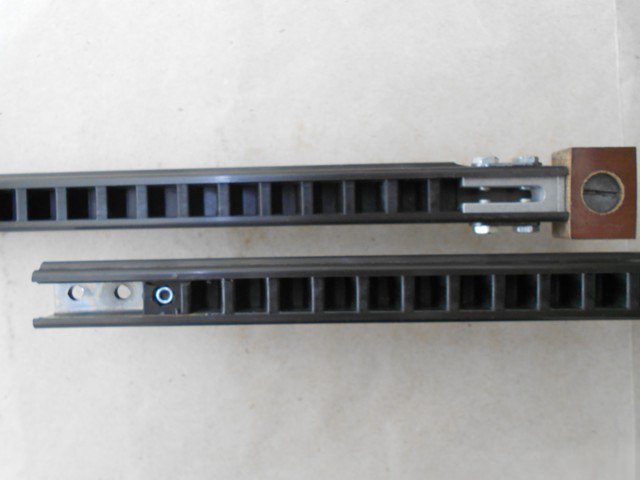
For a new carbon rapier, use VDW Carbon Rapier Male (K4) and VDW Carbon Rapier Female (K5). All rapier parts are listed on the Velvet Loom Parts page.
FAQ
Can a cracked carbon rapier be repaired?
A crack in carbon grows under load. A repaired rapier can fail without warning and damage surrounding parts. We recommend replacement.
Only one of the male and female rapiers broke. Should I replace both?
Not necessarily. But if the break came from a collision, inspect the other rapier carefully for cracks.
How long does a carbon rapier last?
We do not quote a fixed figure. The state of the guides, blocks and setting, plus loom speed and number of shifts, decide it.
If you would like help finding the cause of a carbon rapier breakage, send photos of the broken part and the guides on WhatsApp to +90 541 951 44 10.