The knife that cuts the pile on a velvet loom travels back and forth along a slide on the knife bed. Our catalogue carries two versions of this arrangement: roller type (often called the “bearing” type on the shop floor) and graphite type. They are not interchangeable at random, and the slide type also decides which knife cord you should use and how you maintain it. This article compares the two velvet loom knife bed types and shows how to identify the one on your loom. It is for technicians replacing a knife bed or stocking spares, including overseas mills ordering from us.
What a velvet loom knife bed does
In face-to-face velvet, the pile yarns between the two cloth layers are cut in the middle by a knife moving across the fabric width. The knife bed is the track the knife carriage rolls or slides along. Its job is to keep the knife on the same line, at the same speed and without judder on every pass. Any play in the bed or slide goes straight into the fabric as variation in pile height.
Roller vs graphite: the difference
The two types do the same job in different ways:
- Roller type: the carriage runs on rollers along the bed, so friction is handled by rolling contact.
- Graphite type: the carriage slides on graphite surfaces. Graphite is a material that stays slippery without liquid lubricant.
That difference carries through to maintenance and consumables:
| Topic | Roller type | Graphite type |
|---|---|---|
| How the carriage moves | Rolls on rollers | Slides on graphite |
| Knife cord, as a rule of thumb | Oiled cord | Dry cord |
| First place to look when worn | Play or rough turning in rollers | Grooves or steps in the graphite |
| Complete bed code | B1 Knife Bed Complete, roller | B2 Knife Bed Complete, graphite |
| Slide code | B3 Knife Slide, roller | B4 Knife Slide, graphite |
Running oiled cord on a graphite slide lets the oil trap dust and yarn waste on the graphite, which spoils the sliding action. On light and white velvet, the risk of oil marks is another reason to use dry cord.
Which loom takes which?
Our catalogue does not tie B1 to B4 to a specific loom model. Looms of the same model may run different bed types depending on their build period or equipment, so we do not generalise with statements like “this model is roller, that one is graphite”. The reliable approach is to find out which type is fitted on your loom today.
How to identify it:
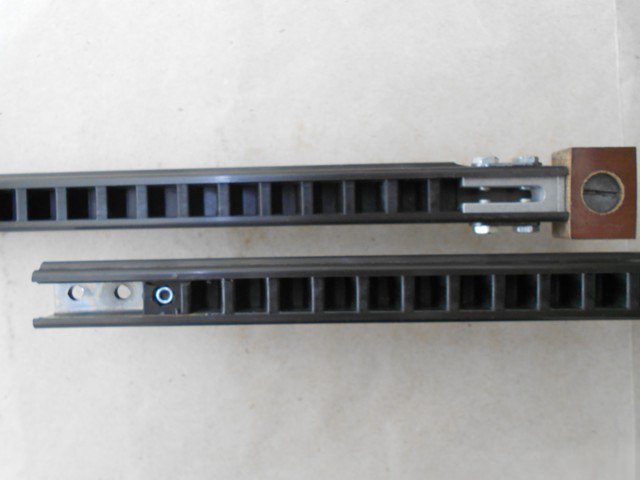
- Move the knife carriage to one end of the loom and look at the underside of the bed.
- If you see rollers that turn, it is the roller type.
- If you see flat, dark grey sliding surfaces, it is the graphite type.
- Note whether you currently use dry or oiled cord; it hints at the previous setup.
- If you are still unsure, photograph the bed and carriage and send the photos to us.
Field note: If you are thinking of changing type, plan the bed, the slide and the knife cord together. Mixed setups, such as a graphite slide on a roller bed or oiled cord on a graphite slide, tend to create a new wear problem rather than solve the old one.
Signs of wear and how to check
Knife beds and slides usually wear slowly, and the first signs appear in the fabric:
- Pile height changing gradually from one selvedge to the other
- The knife carriage seeming to hesitate over a particular section
- On roller beds, irregular noise from the rollers or stiffness when turned by hand
- On graphite beds, visible grooves or steps in the surface
These signs are easy to confuse with knife cord wear. Check the cord first; if it is sound, move on to the bed.
Complete bed or just the slide?
If the wear is only on the slide, replacing the slide (B3 or B4) may be enough. If the bed body is damaged as well, or the loom cannot stand for long, a complete knife bed (B1 or B2) is the quicker fix. We can help you decide from photos. For the rest of the cutting group, see the Knife Group page.
FAQ
Can I convert a roller knife bed to graphite?
Whether a type change is practical depends on your loom’s mounting arrangement. If you are considering it, send photos of the current bed and the loom first and we will look at it with you.
What happens if I use oiled cord on a graphite bed?
The oil holds dust and yarn waste on the graphite, the sliding action deteriorates and wear can speed up. As a rule, graphite slides take dry cord.
How long does a knife bed last?
We will not quote a fixed figure. Loom speed, number of shifts, dust levels and cord choice all decide it. Watching for the signs above is the most reliable approach.
If you are not sure which velvet loom knife bed you have, send a photo of it on WhatsApp to +90 541 951 44 10 and we will find the right code together.