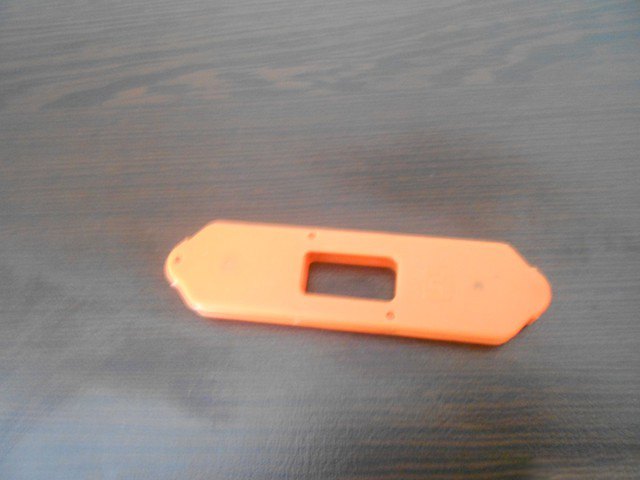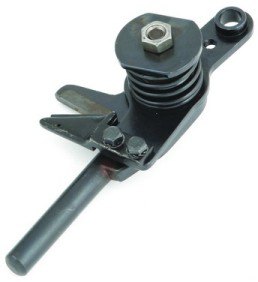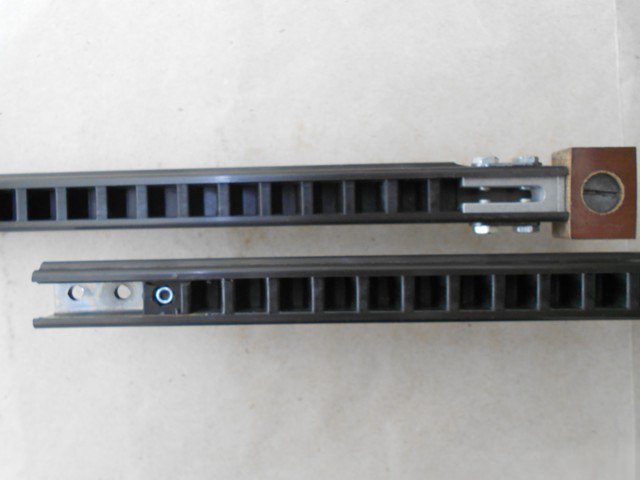
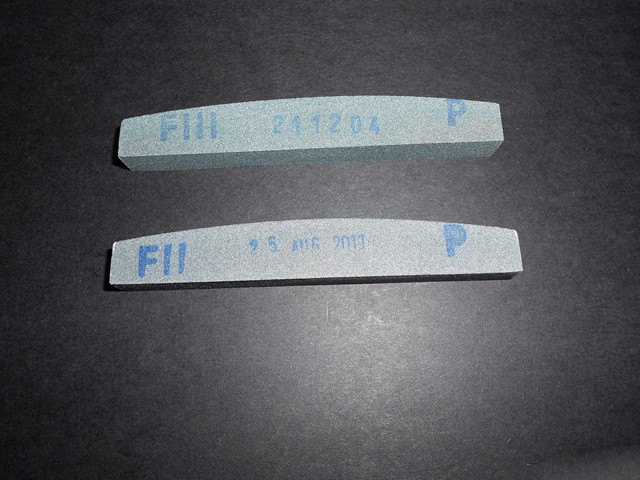
The knife that cuts the pile on a velvet loom is sharpened continuously while the loom runs, and the grinding stone does that job. Our catalogue lists grinding stones under three separate codes: FI, FII and FIII. This article explains how to match the right stone to your loom, when a stone needs replacing and what to watch for when you change it. It is aimed at technicians responsible for the knife group on Van de Wiele velvet looms, including mills that order from us from abroad.
What the grinding stone does on a velvet loom
In face-to-face velvet weaving, the pile yarns between the two cloth layers are cut in the middle by a knife that travels along the slide, pulled by the knife cord. After countless cuts the edge dulls. The grinding stone sits in the knife’s path and keeps refreshing that edge. A stone in good condition gives a clean cut and an even pile. A worn, clogged or wrong-type stone leaves the knife under-sharpened, and you start to see fuzz along the cut line and variations in pile height.
FI, FII and FIII: how to tell which one you need
FI, FII and FIII are separate products in our catalogue and should not be treated as substitutes for each other. We deliberately do not describe the difference here with dimensions, because the correct type is decided by the grinding arrangement on your loom, and the most reliable way to match it is against the stone you already use. Ordering from a guessed dimension table is how the wrong stone ends up on a pallet to another country.
Ways to find the right stone:
- The code on your old stone or its packaging. If you have bought from us before, FI, FII or FIII appears on the invoice or label.
- Photo matching. Photos of the stone from the front, the side and fitted in its holder are usually enough to identify the type.
- Loom model and knife bed type. Telling us whether the loom is an MPS, VMM or VME and whether the knife bed is the roller or graphite type speeds things up.
- Sending a sample. Where there is still doubt, sending the old stone as a sample is the surest method.
Product pages: Grinding Stone FI (B12), Grinding Stone FII (B13), Grinding Stone FIII (B14). The Round Grinding Stone (B5) is listed as a separate type.
When to replace a velvet loom grinding stone
Stone life varies widely with loom speed, number of shifts, the pile yarn being woven and the condition of the knife cord. That is why we recommend replacing on symptoms, not on a calendar.
| Symptom | Likely cause | What to check |
|---|---|---|
| Fuzz along the cut line | Stone worn or clogged | Stone surface, contact with the knife |
| Uneven pile height | Stone worn unevenly or knife cord stretched | Stone surface and knife cord |
| Glazed, shiny stone surface | Surface clogged, less abrasion | Clean or replace the stone |
| Crack or chipped edge | Impact or wrong clamping | Replace at once, check the holder |
| Fuzz continues with a new stone | Problem is not the stone | Knife cord, knife bed, slide |
Field note: If the fuzz along the cut edge does not clear after a stone change, move on to the knife cord. A stretched cord does not bring the knife to the stone in the right position, and even the best stone cannot fix that.
Changing the stone: points to watch
- Stop the loom and bring the knife carriage to an accessible position.
- When removing the old stone, look at the holder; dust and metal fines stop the new stone from seating properly.
- Hold the new stone next to the old one before fitting to confirm it is the same code.
- Do not overtighten the clamp; grinding stone is a brittle material.
- On the first run, watch the cut edge for a few metres.
- If the knife cord is also near the end of its life, change both together and set up once.
How many stones to keep in stock
Rather than quote a number, we suggest this approach: list which stone codes your loom park uses and keep at least one spare for each. If different looms take different stone types, label the shelf by code so the night shift does not fit the wrong stone. To plan stones together with the other consumables in the knife group, see the Knife Group page.
FAQ
What happens if I fit FII instead of FI?
The codes are listed as separate types in our catalogue. Send us a photo of your old stone before fitting a new one and we will confirm the right code together.
Can I clean a stone and reuse it?
A stone that is only clogged with dust can sometimes be cleaned and used a little longer. A cracked, chipped or unevenly worn stone must be replaced.
Does the round grinding stone (B5) do the same job as FI, FII and FIII?
B5 is listed as a separate type. We confirm which one your loom uses from a photo of your current stone.
To find the right grinding stone code for your velvet loom, send a photo of your old stone on WhatsApp to +90 541 951 44 10.