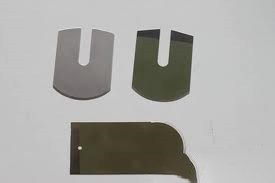
Our catalogue lists the 56x44 fabric cutting blade in five thicknesses: 0.25, 0.30, 0.35, 0.40 and 0.45 mm. The size is the same; only the thickness changes. The question we hear most when these are ordered is simple: “Which thickness should I buy?” This article explains what blade thickness affects, how to find the right one for your loom and what to check when you change blades. It is for velvet loom technicians and buyers, including export customers who order by code.
The 56x44 fabric cutting blade codes
Each thickness has its own product code:
| Code | Product | Thickness |
|---|---|---|
| B15 | Fabric Cutting Blades 56x44x0.25 | 0.25 mm |
| B16 | Fabric Cutting Blades 56x44x0.30 | 0.30 mm |
| B17 | Fabric Cutting Blades 56x44x0.35 | 0.35 mm |
| B18 | Fabric Cutting Blades 56x44x0.40 | 0.40 mm |
| B19 | Fabric Cutting Blades 56x44x0.45 | 0.45 mm |
The thickness values are those in the product names. We do not publish further dimensional or material data.
What blade thickness changes
Thickness can affect how the blade behaves during cutting, but exactly how it shows up depends on your loom’s model and setup, so we do not give a fixed rule. Points generally worth watching are:
- Flex: thickness can affect how much the blade flexes as it passes between the cloth layers. You will need to observe the actual behavior on your own loom.
- Gap between the layers: the blade runs between the two cloth layers, so its thickness has to suit that gap. The gap is set by the loom setting and the fabric construction.
- Grinding: how the blade meets the stone and the edge it takes after grinding are linked to thickness. If you change thickness, review the grinding arrangement too.
- Setting: the loom is set up for the blade thickness it currently runs. A different thickness means rechecking the setting.
That is why we do not publish a table of “this fabric, that thickness”. The right blade depends on your loom setting and the fabric you weave.
How to find the right thickness
The most reliable reference is the blade already running well on your loom:
- The box or invoice of your current blades: if you bought from us before, the code (B15 to B19) is on it.
- Measure it: a micrometer on an unused spare blade gives the thickness directly. A used blade may be worn, so measure a spare or lightly used one.
- Your loom manual: if it specifies a value, go by that.
- Ask us: send the loom model, the fabric type you weave and a photo of your current blade.
Field note: If you want to trial a different thickness, do it on one loom, not the whole weaving shed. Compare pile surface and cut edge over a few rolls against a loom on the old setup, then decide.
When a thickness change comes up
Mills usually consider a different thickness when:
- They move to a new fabric quality or a different pile yarn
- Fuzz along the cut edge persists even after the cord, stone and bed have been checked
- Blade breakage becomes more frequent
In the last two cases, check the rest of the cutting group before changing thickness. Fuzz and uneven pile usually come from the knife cord or grinding stone, and a thickness change can hide the real cause.
Changing blades: points to watch
- Stop the loom and bring the knife carriage to an accessible position.
- Compare the new blade’s code and thickness with the old one before fitting.
- Clean the blade seat; dust and yarn waste stop the blade sitting properly.
- Wear gloves; the edges are sharp.
- On the first run, watch the cut edge and pile surface for a few metres.
For the rest of the cutting group, see the Knife Group page.
Storing blade stock
Cutting blades are thin and sharp, and poor storage can damage them before they ever reach the loom. Some suggestions for your stores:
- Separate boxes by thickness: the five thicknesses are hard to tell apart by eye. Keep each code in its own labelled box, with both the code (B15 to B19) and the thickness on the label.
- Keep them dry: store blades in a dry place in their original packing. Rust ruins the cutting edge.
- Protect the edge: do not pile blades loosely so they rub against each other; the edge can pick up nicks.
- Keep used and new apart: never put removed blades back in the box of new ones. A used blade that gets mixed in will cause cutting trouble at the next change.
If several looms run different thicknesses, a simple list on the blade cabinet door showing which loom takes which code prevents mix-ups at shift change.
FAQ
Can I run different thicknesses on the same loom?
Mixing thicknesses in one cutting arrangement can spoil cut consistency. We recommend a single thickness per arrangement.
Does a thicker blade last longer?
Blade life does not depend on thickness alone; loom speed, grinding, pile yarn and setting all play a part. We therefore do not compare lifetimes by thickness.
Can I order mixed thicknesses?
Yes. If different looms use different thicknesses, just give the quantity for each code in your order.
If you are unsure which 56x44 fabric cutting blade thickness suits your loom, send a photo of your current blade and your loom model on WhatsApp to +90 541 951 44 10.